— Sayed Habib
Charlie Chaplin once wrote in his autobiography that if you look at life in close-up, it appears to be a tragedy, but if you step back and see it from a long shot, it looks like pure comedy. A clown stumbles over his own trousers in the circus ring to make others laugh, and the audience applauds, but no one knows what kind of generous heart is wounded beneath that loose-fitting costume.

When news of Mushtaq Khan’s death came from a Mumbai hospital on Thursday evening, Chaplin’s philosophy flashed through my mind. At just 56, the ruthless script of cancer has taken away an artist who spent four decades spreading smiles on the screen.
Cinema has a strange canvas. The entire universe of light is often devoted to the leading characters, while the faces that actually breathe life into a film’s frames are frequently pushed to the margins. We call them “character actors” or “character artists.” Mushtaq Khan was a true soldier of that fraternity.
Emerging from the soil of Baihar, a small town in Madhya Pradesh’s Balaghat district, the young man entered the dream city of Bombay with the fire of acting burning in his eyes. He began facing the camera with Saeed Akhtar Mirza’s acclaimed film Albert Pinto Ko Gussa Kyoon Aata Hai? (1980). From the seriousness of parallel cinema to the masala films of the 1990s, he adapted himself to every shade of the industry.
Whether it was Mahesh Bhatt’s romantic Aashiqui, Aamir Khan’s playful Hum Hain Rahi Pyar Ke, Priyadarshan’s classic Hera Pheri, or David Dhawan’s Jodi No. 1—whenever Mushtaq Khan entered the frame, the heaviness of the atmosphere seemed to disappear.
He was not an actor who simply memorised his lines and delivered them. The movement of his eyebrows, the playfulness of his eyes and the pauses between his dialogues made his comic timing extraordinary.
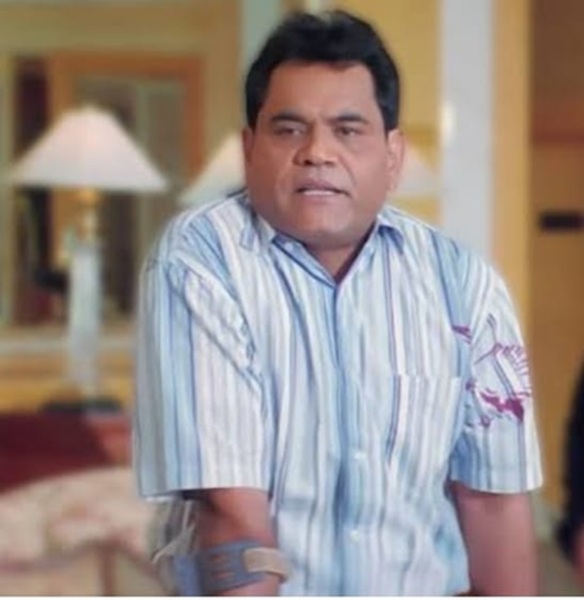
Who could forget that scene from Anees Bazmee’s Welcome (2007)?
“Meri ek taang nakli hai, main hockey ka bahut bada khiladi tha…”
The dialogue has become immortal in the meme culture of today’s digital generation. But reducing an artist’s four decades of practice to a single dialogue would be unfair to him. In recent years, too, he continued to prove that the art of acting does not grow old, with his appearances in films such as Stree 2, Gadar 2 and Badhaai Do.
In the television serial Kuch Rang Pyar Ke Aise Bhi, he showed that he was not merely a clown whose job was to make people laugh, but also a sensitive actor capable of bringing the nuances of human relationships to life.
But sadly, life does not have the happy-ending climax of a film.
For quite some time, he had been battling the final and incurable stage of cancer, alone against an illness in which physical pain eventually reaches the soul. When, at around 7 p.m. on Thursday, he left behind his wife Salma and their two sons and bid a final farewell to this mortal stage, one colour of the cinematic screen faded forever.
The show must go on…
Cinema will continue. New films will arrive. New faces will laugh and make others laugh. But whenever a simple, innocent man smiles at his own fate while confronting a cunning world, the laughing face of Mushtaq Khan will come back to memory.
Farewell, Mushtaq Sahab! The debt of laughter you gave us is being repaid today by cinema with moist eyes.
About Author

You may also like
Scientific Ways to Keep Your Home Pollution-Free Amid Rising AQI Levels in Winter
Behind the Glitz : The Struggle of Bodies, Jewels and Lives in the Marketplace of Glamour
Asian Games 2026: India in 5th Place in Medal Table, China Maintains Dominance; Men’s Hockey Team to Face Malaysia Today
Jai Shri Ram Slogans Raised During CJP Protest at Mumbai’s Shivaji Park; Police Bring Situation Under Control
Five Years of Royal Revelry on the Chest of Udai Sagar