
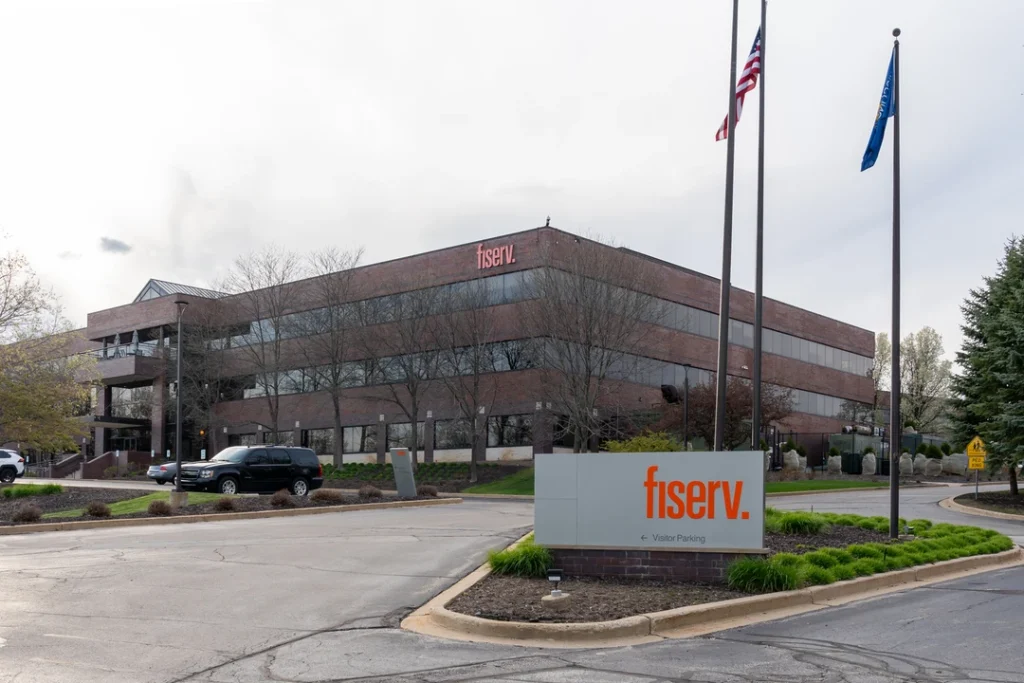
At the close of trading, Fiserv’s stock price was around $126.17, down sharply from a recent level near $143, marking one of the steepest drops in the company’s history. The decline reflects growing investor unease about the company’s financial trajectory, competitive landscape, and strategic clarity in the rapidly evolving fintech sector.
The payment-technology giant adjusted its organic revenue growth outlook from approximately 10% to a much lower 3.5%–4.5%, while also trimming its adjusted earnings-per-share forecast from nearly $10.30 to around $8.50–$8.60. This reset caught investors off guard, eroding confidence in Fiserv’s near-term growth momentum.
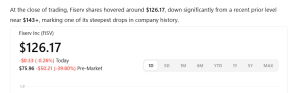
Although recent quarterly results showed healthy performance — including roughly 8% year-over-year organic revenue growth and a 16% rise in adjusted earnings per share — these positives were overshadowed by the weaker-than-expected outlook. Analysts and investors interpreted the reset as a signal of reduced visibility, softer business momentum, and execution challenges within key business segments.
Several broad factors appear to have contributed to the disappointing update.
Fiserv has faced delays in product rollouts and longer implementation timelines for major initiatives, which slowed revenue realization. Broader macroeconomic headwinds — including changing consumer spending behavior and slower merchant activity — also pressured growth across financial and payments solutions. Additionally, a leadership transition earlier this year, with a new CEO and incoming CFO, has raised questions about management stability and strategic direction.
The fintech industry is increasingly competitive, with rivals advancing aggressively in digital payments, small-business platforms, and cloud-based financial technology. As Fiserv works to defend its market share, investors are closely watching whether its innovation pipeline and integration efforts can sustain future growth.
For U.S. investors, Fiserv’s sharp stock decline highlights the volatility and uncertainty inherent in the fintech sector. While the company remains a key player in payment solutions and digital banking, its lowered guidance and weakened sentiment signal a need for clearer communication, stronger execution, and restored investor confidence.
In summary, Fiserv’s record stock drop following its outlook revision underscores how quickly market sentiment can shift when expectations are reset. Despite its long-term potential, the company now faces the challenge of rebuilding credibility and demonstrating that it can deliver consistent, sustainable growth in a competitive financial technology landscape.
About Author

You may also like
जावर माता एग्रो फार्मर प्रोड्यूसर कंपनी की एजीएम : 1865 शेयरधारकों के साथ 27.27 लाख का वार्षिक कारोबार, किसानों की आय दोगुनी करने के लिए आधुनिक तकनीक पर जोर
उदयपुर की पैराडाइज लेक में कॉलेज छात्रा की डूबने से मौत: परिजनों और समाज ने गोवर्धन विलास थाने पर किया प्रदर्शन; छुट्टी के दिन तैराकी ले जाने पर खड़े किए सवाल
राजस्थान विद्यापीठ : अखबार में छपे आरोपों पर कुलाधिपति और कुलपति का तीखा पलटवार, पूर्व वीसी को ठहराया आर्थिक तंगी का जिम्मेदार
नारायण सेवा संस्थान के सेवा महातीर्थ में 47वें नि:शुल्क दिव्यांग एवं निर्धन सामूहिक विवाह समारोह का आगाज; हल्दी-मेहंदी की रस्मों से महका लियों का गुड़ा
सपनों को मिला अपनों का संबल : नारायण सेवा के प्रांगण में 50 दिव्यांग-निर्धन जोड़ों ने थामी एक-दूसरे की जीवन-डोर