
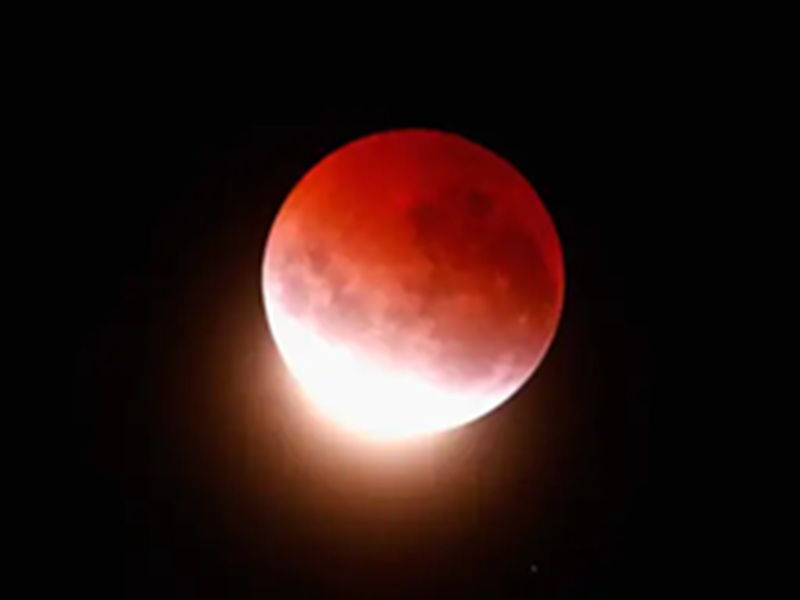

New Delhi — The Sutak Kaal has begun ahead of the first lunar eclipse of 2026. Temples across the country were closed on Tuesday morning after the Mangala Aarti. The doors will reopen after the eclipse ends at 7 PM. Following the reopening, idols will be ritually bathed, decorated, and special prayers will be offered. Temples will remain open until night after the Bhog Aarti.
At the Shri Mahakaleshwar Temple in Ujjain, Holi celebrations were held during the traditional Bhasma Aarti on Tuesday morning before the temple gates were closed.
According to the India Meteorological Department (IMD), a total lunar eclipse will occur on Tuesday, March 3, 2026. The eclipse will be visible in India. It will begin at 3:21 PM and continue until 6:47 PM.
Among the prominent temples closed during the eclipse are:
Tirupati Balaji Temple
Ram Mandir
Meenakshi Amman Temple
Laxminarayan Temple
Banke Bihari Temple
Ritual Purification After the Eclipse
In Hindu tradition, a lunar eclipse holds religious and astrological significance. The Sutak Kaal, considered an inauspicious period, begins a few hours before the eclipse. During this time, temple doors are closed, religious activities are paused, and devotees are advised to avoid eating or performing auspicious tasks.
After the eclipse ends, temples undergo purification rituals, including ceremonial bathing of the deity and special prayers, before reopening to devotees.
What Is a Lunar Eclipse?
A lunar eclipse occurs due to gravitational forces that cause the Earth to revolve around the Sun (taking 365 days for one orbit), while the Moon, Earth’s natural satellite, revolves around the Earth in about 27 days.
A lunar eclipse takes place when the Earth comes between the Sun and the Moon, blocking sunlight from reaching the Moon. As the Earth’s shadow falls on the Moon, the eclipse occurs.
This alignment happens only when the Sun, Earth, and Moon are in a straight line—an event possible only on a full moon day.
Types of Lunar Eclipses
Total Lunar Eclipse: Occurs when the Earth completely covers the Moon with its shadow, causing it to darken entirely.
Partial Lunar Eclipse: Happens when only a part of the Moon enters the Earth’s shadow.
Penumbral Lunar Eclipse: Occurs when the Earth’s outer shadow falls on the Moon. This type is often difficult to observe.
Why Does the Moon Appear Red?
During a total lunar eclipse, the Moon may appear red, often called a “Blood Moon.” This happens because sunlight passing through the Earth’s atmosphere scatters shorter wavelengths (like violet and blue), while longer red wavelengths reach the Moon and reflect back to Earth, giving it a reddish appearance.
How Often Do Lunar Eclipses Occur?
According to NASA, typically two lunar eclipses occur in a year, though sometimes there may be three. About 29% of all lunar eclipses are total eclipses. On average, a total lunar eclipse is visible from a particular location once every 2.5 years, lasting between 30 minutes and one hour.
Historical Observations
Ancient records from China’s Zhou dynasty mention lunar eclipses centuries ago. Greek scientists also used lunar eclipses to calculate the Earth’s diameter and estimate the distance between the Earth and the Moon. Later, Claudius Ptolemy incorporated such astronomical observations into one of the earliest known world maps.
About Author

You may also like
Udaipur Municipal Corporation Election – Ward 75: Aravalli’s Sun, a Courtyard of 36 Communities and 14 Years in Political Exile
Udaipur’s Political Test: Pramod Samar’s Patience, Simplicity and Vision for Ward 51
Comeback of Anil Singhal
FIFA World Cup 2026 : Canada Reaches the Round of 16 for the First Time, While Lionel Messi and Harry Kane Create New Records
FIFA World Cup 2026 : Ronaldo Creates History as Portugal Thrash Uzbekistan 5-0, Becomes First Player to Score in Six World Cups