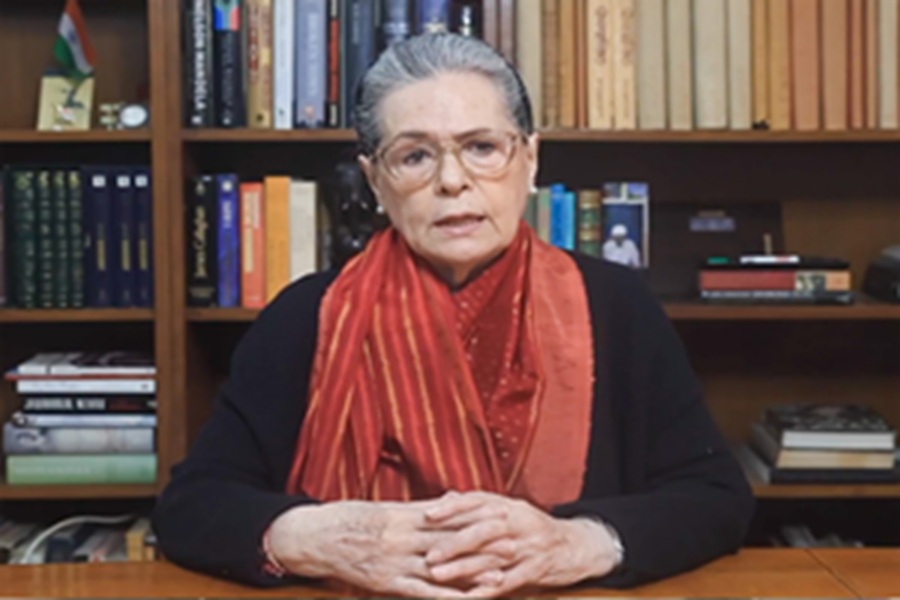

New Delhi — Congress Rajya Sabha MP Sonia Gandhi has questioned the Indian government’s silence over the killing of Iran’s Supreme Leader, Ayatollah Ali Khamenei. She described New Delhi’s silence as “surprising,” saying it reflects not neutrality, but a retreat from responsibility.
In an article published in The Indian Express on Tuesday, Sonia Gandhi wrote that on March 1, Iran confirmed that its Supreme Leader had been killed a day earlier in a targeted attack allegedly carried out by the United States and Israel. She stated that the killing of a sitting head of state during ongoing diplomatic-level talks represents a serious rupture in contemporary international relations.
She further noted that the Government of India neither condemned the killing nor issued a clear response regarding the alleged violation of Iran’s sovereignty. According to her, Prime Minister Narendra Modi did not criticize the U.S.-Israel strike and instead condemned only Iran’s retaliatory actions against the UAE. She added that while the Prime Minister later expressed “deep concern” and called for dialogue and diplomacy, the attack had taken place during an active diplomatic process between the two nations.
Five Key Points from Sonia Gandhi’s Article
1. Killing Without Declaration of War
Sonia Gandhi argued that the assassination occurred without a formal declaration of war and during ongoing negotiations. She cited Article 2(4) of the UN Charter, which prohibits the threat or use of force against the territorial integrity or political independence of any state. A targeted killing of a sitting head of state, she said, violates these principles. If the world’s largest democracy does not speak out, it could weaken international norms.
2. Prime Minister’s Visit to Israel
She pointed out that the Prime Minister had returned from an Israel visit just 48 hours before the killing, where he reiterated support for the Benjamin Netanyahu government. This, she said, occurred amid global outrage over civilian casualties in Gaza, including women and children.
3. Global South and BRICS Position
According to her, several Global South countries and BRICS partners such as Russia and China have maintained distance on the issue. In such a context, India’s open support without a clear moral stance could send the wrong message and have global implications beyond regional politics.
4. Condemnation of Bombing and Targeted Killing
The Indian National Congress, she said, strongly condemns the bombing on Iranian soil and the targeted killing, describing them as dangerous for both the region and the world. She expressed solidarity with the people of Iran and the Shia community worldwide.
5. Reference to the Constitution
Sonia Gandhi cited Article 51 of the Indian Constitution, which emphasizes resolving international disputes through dialogue, respecting equality among nations, and non-interference in internal affairs. She said these principles have long guided India’s foreign policy, and the current silence does not align with them.
Reference to India–Iran Relations
Sonia Gandhi recalled that in 1994, when some OIC countries attempted to raise the Kashmir issue against India at the UN Human Rights Commission, Iran played a significant role in preventing the resolution from moving forward. She also mentioned Iran’s permission for India to maintain a diplomatic presence in Zahedan near the Pakistan border, which holds strategic importance in the context of Gwadar Port and the China-Pakistan Economic Corridor.
She further referred to former Prime Minister Atal Bihari Vajpayee’s 2001 visit to Tehran, where bilateral ties were reaffirmed.
India–Israel Relations and Credibility
Sonia Gandhi acknowledged that India–Israel relations have strengthened in recent years in defense, agriculture, and technology. Since India maintains ties with both Tehran and Tel Aviv, she argued that it is well positioned to call for restraint—but only if it preserves its credibility by adopting a principle-based stance.
She emphasized that nearly 10 million Indians live and work in Gulf countries. During crises such as the Gulf War and conflicts in Yemen, Iraq, and Syria, India was able to safeguard its citizens because it was viewed as an independent and impartial nation, not as a representative of any particular power bloc.
She stated that India’s post-independence foreign policy was based on non-alignment, which signified strategic autonomy rather than passive neutrality. The current situation, she suggested, signals a weakening of that approach. If India does not speak clearly on issues of sovereignty in Iran’s case, smaller nations may question its reliability in the future.
Demand for Parliamentary Debate
Sonia Gandhi called for an open debate in the next session of Parliament on the targeted killing of Ayatollah Ali Khamenei, the government’s silence, and the broader implications for international law and sovereignty.
She concluded that the erosion of international norms and growing instability in West Asia directly affect India’s strategic and moral interests. Invoking the principle of “Vasudhaiva Kutumbakam,” she said it represents not merely a slogan but a commitment to justice, restraint, and dialogue. In times when the rules-based international order is under pressure, remaining silent amounts to stepping back from responsibility.
About Author

You may also like
Behind the Glitz : The Struggle of Bodies, Jewels and Lives in the Marketplace of Glamour
Asian Games 2026: India in 5th Place in Medal Table, China Maintains Dominance; Men’s Hockey Team to Face Malaysia Today
Jai Shri Ram Slogans Raised During CJP Protest at Mumbai’s Shivaji Park; Police Bring Situation Under Control
Five Years of Royal Revelry on the Chest of Udai Sagar
Gen Z Dating Millennials: Indian Singles Share the Pros and Cons of Cross-Generational Relationships